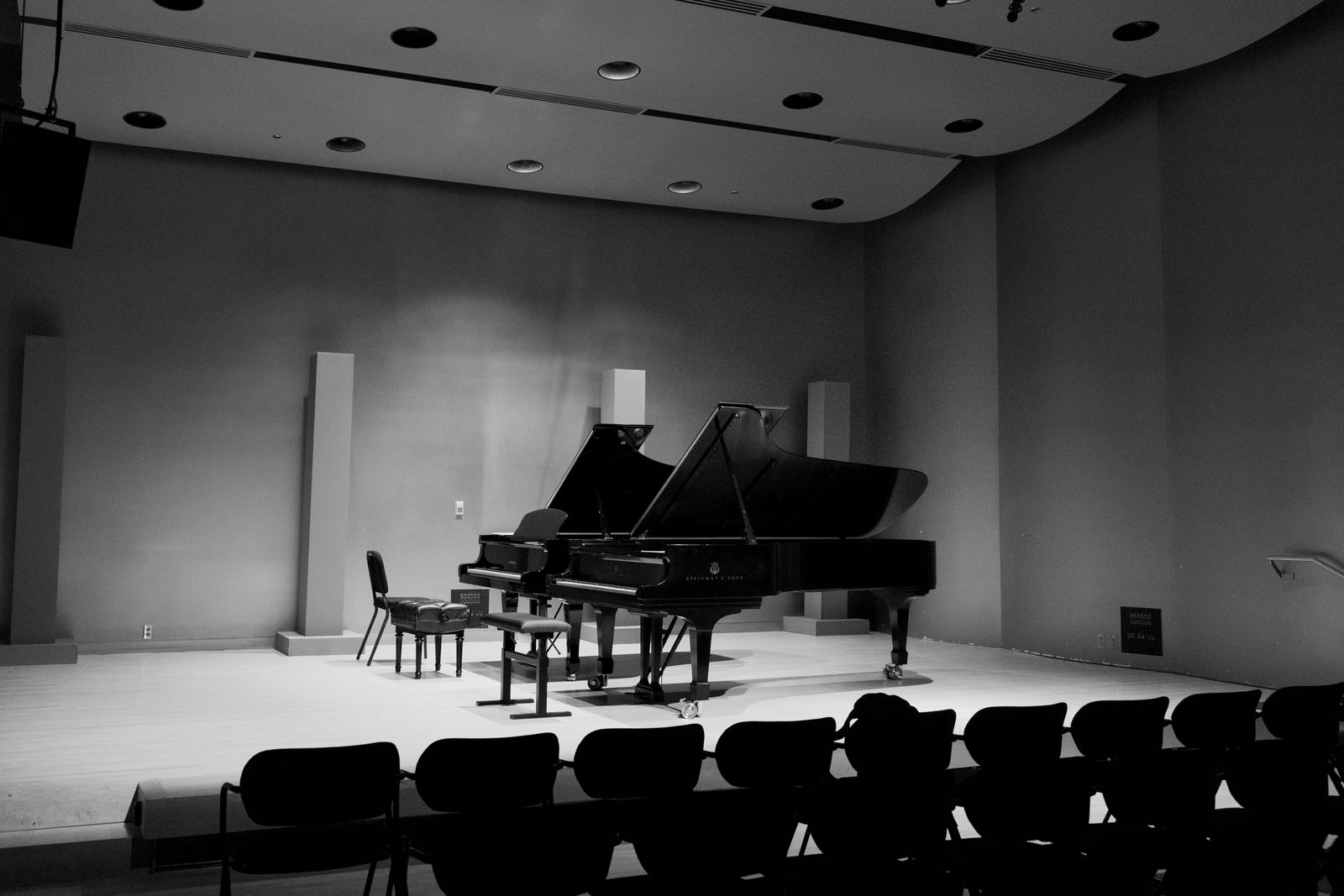
Ravel. Precision and vertigo.
What happens when the complete piano works are heard as a journey rather than a gallery of isolated feats.
Look beyond the famous piece.
One Ravel piece can be enough to occupy an evening in the memory: the concentration of a gesture, difficulty taking the shape of an image, the moment when the piano becomes something other than a keyboard. Hearing the works together changes the perspective. What seems exceptional in one piece may reveal itself as part of a continuous thought. A complete cycle does more than lengthen a programme: it shifts the position from which we observe it.
Writing in Musica, Nicola Cattò described Jean-Efflam Bavouzet’s performance of Ravel’s complete piano works in Ravello in August 2026. The programme’s chronology and the attention to clarity form two axes of his account. [1] That testimony opens a wider question: how much of Ravel’s virtuosity do we understand when we separate it from the architecture that makes it necessary?
Colour does not conceal structure.
Cattò’s review relates intelligibility to pianistic tension without reducing the result to a comparison of speed or power. [1] The distinction offers a way back into Ravel: difficulty is not merely a surface to be crossed. It can be the means by which the writing produces distance, relief and movement simultaneously, asking the pianist to make several levels perceptible as parts of one space.
Listeners need not follow every note to feel this. They can hear whether a figure maintains direction, whether a voice emerges without breaking continuity and whether a climax has been prepared or is simply louder. Control becomes expressive when it does not feel like restraint: it is the measure that makes even the point of greatest instability convincing.
Virtuosity can be the most exact way of making a thought legible.Musicforgestudio Journal
A waltz imagined over many years.
The Bibliothèque nationale de France’s digital collections offer a documentary counterpoint. Its Gallica selection on Ravel identifies a February 1906 letter to Jean Marnold discussing a Viennese waltz and an April 1920 letter to Georgette Marnold announcing the completion of La Valse. [2] The distance between those traces reminds us that a work does not coincide with the instant at which we encounter it in a programme.
Recovering that long span changes the meaning of immediacy. A piece may feel irresistible, almost inevitable, while emerging from an imagination that changed shape over years. Letters do not explain every bar or replace listening; they restore duration to the work. Final precision does not exclude waiting, just as the assurance of a performance does not erase the many possibilities preceding a choice.
A journey that brings details back into focus.
Listening to a complete cycle should not become an endurance test. It can instead exercise memory between works: recognising a recurring problem, a distribution of weight or a different response to the same question of movement. Even when we return to a single piece, that context remains. A detail is no longer isolated; it belongs to a network of correspondences.
Ravel then acquires a less obvious dimension of enchantment. His music need not choose between exactness and imagination: it can construct the latter through the former. A pianist who makes its balances perceptible does not diminish the vertigo. The performance gives it an edge, a point of reference from which the ear can measure how far it has travelled.
05 / References
and sources
Account of Jean-Efflam Bavouzet’s complete cycle on 27 August 2026. MFS does not claim to have attended this performance.
Sources checked on 3 November 2026.
Manuscript and letter collections; correspondence with Jean and Georgette Marnold and the gestation of La Valse.
Listening and working suggestions are editorial interpretations; documented facts link to the numbered references.
06 / Author
Musicforgestudio’s editorial voice explores artists, musical culture and sound research.